Africa’s growing gambling use is sapping income that would ordinarily be flowing into groceries, entertainment and mobile phone bills.
The leaders of the continent’s largest companies are now warning about the harm the trend is inflicting on household budgets.
“People are spending money in a black hole that could have spent on food,” said Pieter Engelbrecht, the chief executive officer of Africa’s largest grocer Shoprite Holdings.
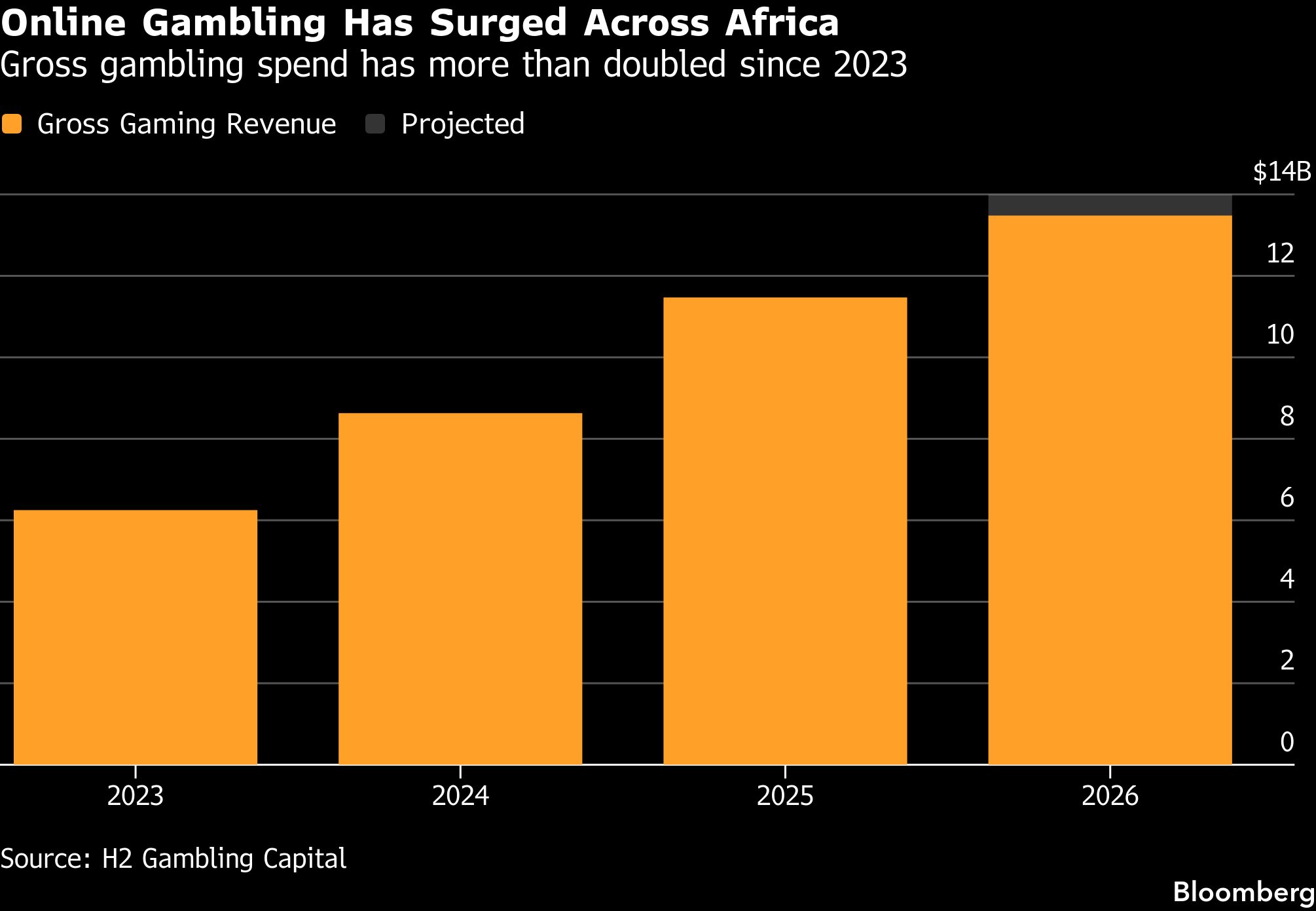
Online betting is mushrooming across Africa, with gross gaming revenue projected to reach $13.5 billion this year, more than double its 2023 level, according to data from H2 Gambling Capital.
Fuelled by a young, fast-growing population, rising smartphone use and weak regulation, betting firms are rapidly drawing in users, leaving their customers with less money to spend on other discretionary items.
South Africa’s Treasury called it an “important policy concern” that may need government intervention in the form of further regulation and taxation, a spokesperson told Bloomberg.
As spending on online betting rises, it is contributing to financial distress among heavy users. The average share of income spent on gambling doubled to 2% between 2021 and 2025, according to research by Africa’s largest bank, Standard Bank, shared with Bloomberg News.
Spending is highly uneven: about 7% of people spend more than 100% of their income on gambling, according to the research, relying on credit and other supplementary proceeds.
In South Africa, the continent’s largest economy, spending on betting has risen about 50% each year over the past three years, even as overall consumer spending weakens, according to data from Absa Bank. The rise in gambling is accompanied by rising borrowing — and missed loan payments.
Absa’s CEO Kenny Fihla said that gambling trends are a “huge predictor” of loan delinquency. “The more clients become indebted, the more they gamble and the bigger the hole becomes,” he said during an earnings call last month.
“This is a massive problem that quite frankly, we’re worried about,” he said.
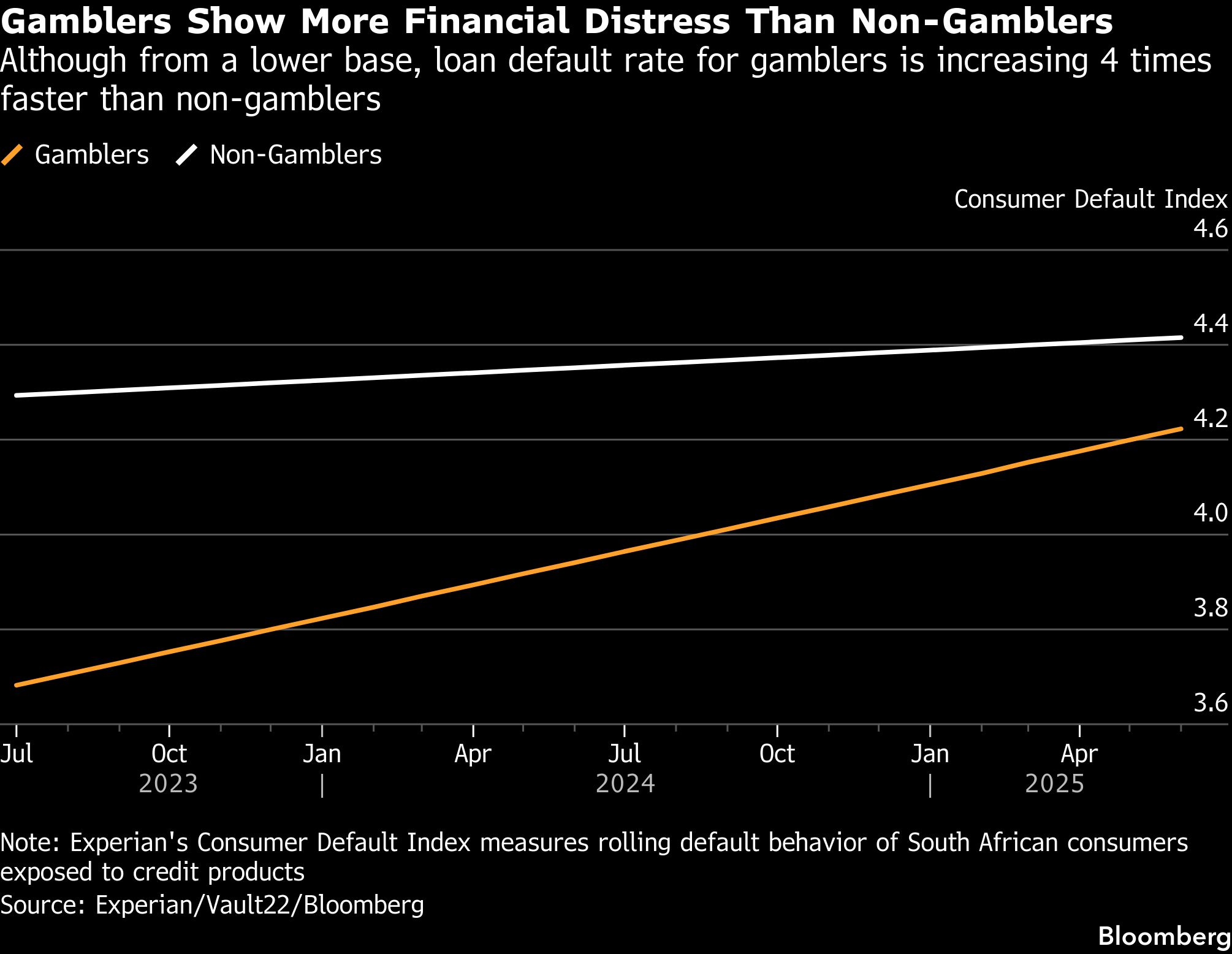
Over the past few years, the loan default rate for gamblers in South Africa has been increasing four times as fast as the rate in non-gamblers, rising 2% month on month, according to data published last year by Experian and finance app Vault22.
Gambling has become the twelfth highest category in the country’s consumer price index, just behind beer. It now represents more than half (54.5%) of spending on leisure activities like sports, movies and gym memberships, according to the state statistics agency.
It’s even affecting mobile operators, according to Africa’s largest wireless carrier MTN Group. The company said that “muted” growth on prepaid mobile in South Africa is “exacerbated by the growing share of disposable income that is being spent on online gambling,” according to its 2025 annual report, published last month.
Fashion brands are also feeling the gambling-linked squeeze, according to the CEO of retail group Woolworths Holdings. “Because gambling taps into the consumer’s discretionary wallet, there are parts of our business that are more vulnerable,” Roy Bagattini told Bloomberg News.
“People are blowing their salaries on online gambling before they pay rent, school fees, transport,” said Oscar Bishop, a recovering gambling addict and now ambassador of the South African Responsible Gambling Foundation. “The pandemic of online gambling is way, way out of hand.”
At the height of his addiction, Bishop would buy “less and less groceries every month,” and make up excuses to his family that he needed to repair his car, he said.
Bishop called for better regulation, bans on advertising, and a limit to how much people can spend on gambling each month. Online betting is largely regulated on a provincial level, although many offshore casinos target South Africans without a license.
Betting firms are capitalizing on the surge in demand. New York-listed Super Group, which operates Betway and Spin, exited the US to focus on faster-growing markets across Africa.
Its revenue on the continent grew 27% in 2025, largely driven by South Africa. Momentum is building there: Virgin Bet entered the market in March and the number of sportsbetting licenses has climbed to 400, up 40% from the 2020/2021 financial year, according to the trade ministry.
Super Group and Virgin Bet declined to comment.
Ulrik Bengtsson, the CEO of Sunbet operator Sun International, said that although household spending on gambling has risen, it remains low relative to spending on essential goods and services.
A licensed, tax-paying industry is the “solution to consumer protection, not the problem,” he said, contrasting his business with the “thousands of offshore platforms already targeting South African consumers beyond any regulatory reach.”
Sun International has co-founded an industry body for licensed operators to help develop better gambling regulation.
In November, South Africa’s Treasury opened a public consultation on how an online gambling tax could help offset some of the social costs associated with problem gambling, “including financial stress, reduced productivity, family hardship and adverse mental health outcomes,” a spokesperson told Bloomberg.
Feedback from the public consultation will be discussed in a workshop and help shape draft national legislation for the proposed gambling tax later this year, the spokesperson added.
Efforts to update the country’s 2004 gambling regulation for a digital age have repeatedly stalled, according to Toby Chance, a member of parliament for the Democratic Alliance.
“Political will has been absent,” he said, adding that the country was being “robbed” by illegal operators not paying their fair share of tax.
© 2026 Bloomberg