
 Staff Writer
Almot Maqolo in Beijing
TRADE and infrastructure have long defined China-Africa relations, but another partnership is quietly taking shape inside university lecture halls.
Each year, thousands of African students complete degrees in China, returning home with ambitions to apply what they have learned to the economic and social challenges facing their countries.
That growing investment in human capital was on display at Renmin University of China recently, where more than 13 African students were among thousands of graduates awarded master’s degrees during the university’s summer commencement ceremony.
While the ceremony marked the end of years of study, for many African graduates, it also marked the beginning of a new chapter.
They now hope to use the knowledge and experience gained in China to contribute to development in their home countries.
The graduates completed postgraduate programmes in public administration, urban governance and development economics.
These are fields that are becoming increasingly important as African governments work to strengthen institutions, improve public services and grow their economies.
Education has become an important part of China-Africa cooperation.
While roads, railways and trade agreements often receive the most attention, education is quietly building a new generation of professionals who could shape Africa’s future.
According to official figures, more than 80 000 African students study or receive vocational training in China each year, while more than 300 000 have benefited from Chinese scholarships and academic exchange programmes.
For many graduates, studying in China is about more than earning a qualification, it is also about learning from a country that has transformed its economy over the past four decades through industrialisation, urban development and investment in infrastructure.
Zimbabwean graduate Charity Munjoma believes those experiences can help her home country.
“Since China and Zimbabwe have bilateral relations, I want to take the knowledge from China to Zimbabwe,” she said after receiving her master’s degree in public administration and policy.
“We are a developing country, and we can also copy what China has done through the education that they have imparted to us.”
Her comments reflect what many African students believe.
Economic development depends not only on investment and infrastructure but also on skilled people who can design policies, solve problems and improve public institutions.
Economists have long argued that investment in people is one of the most important drivers of economic growth.
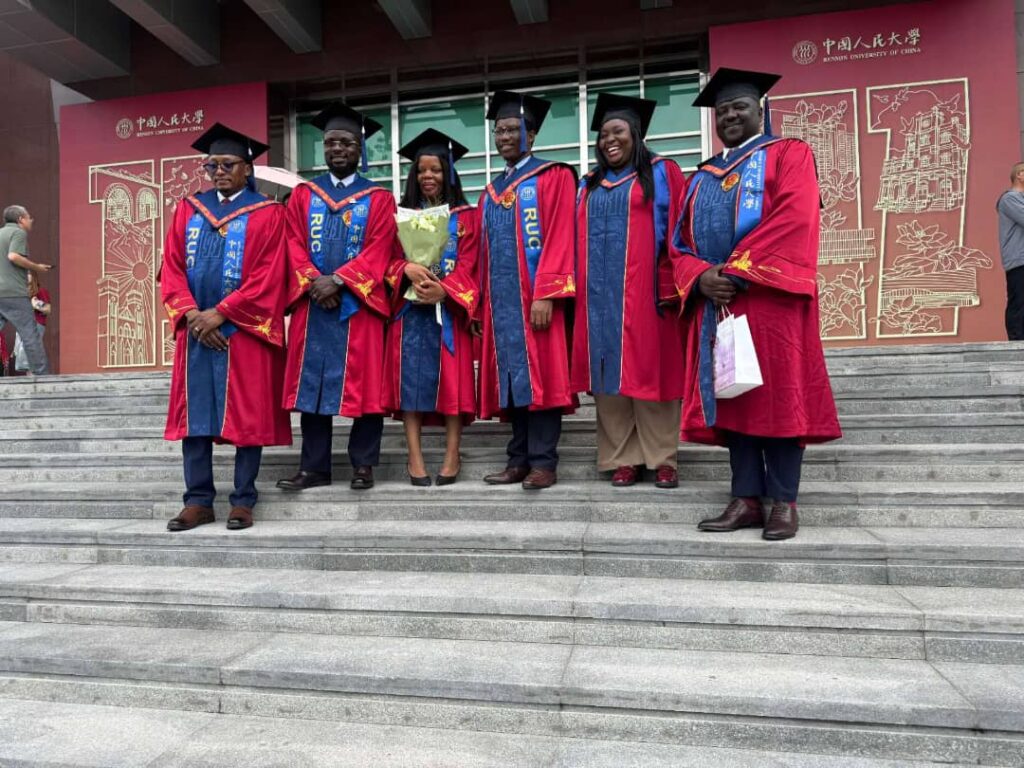
A group of African students pose for a picture after being awarded their master’s degrees in several disciplines at Renmin University of China.
As African countries seek to industrialise, diversify their economies and create jobs, the demand for highly skilled professionals continues to grow.
Botswana’s Moemedi Bosupeng sees his education as an opportunity to contribute to her country’s development.
Having specialised in urban governance and planning, he hopes to apply what he learnt to improve planning and development in Botswana.
“You know, this is an achievement for me, not only for me but also for my country,” he said.
“So, my plan is to go back and actually implement what I have learned.”
Bosupeng said he plans to work within Botswana’s planning systems and compare what he learnt in China with the policies used at home.
“What I am going to do is to go back, try to go into my country’s plans and see how they implement them according to what I have learned,” he said.
He also hopes to continue his studies.
“Then after a year, I will go and apply for a PhD, probably in any other country. Maybe I will come to China, maybe I will go to Australia or go to Europe.”
His plans show that many young African professionals see learning as a lifelong process and believe advanced education will help them make a bigger contribution to their countries.
For Sierra Leone’s Musa Ibrahim, the master’s degree is also a stepping stone.
“My plan is to continue with my PhD after the master’s,” he said.
“Then I will go back home and settle my life.”
His comments reflect the growing importance of postgraduate education as African countries seek professionals with specialised knowledge and skills.
Education experts say international study programmes are “long-term investments” in human capital.
Graduates return with technical knowledge, professional networks and new ideas that can help governments, businesses and institutions respond to development challenges.
China’s universities have become an important destination for African students studying subjects such as economics, engineering, technology, public administration and urban planning.
They leave not only with academic knowledge but also with first-hand experience of China’s economic development and governance systems.
For African countries, the return of highly trained graduates means a growing pool of professionals who can contribute to policy making, business, research and public administration.Their skills could help improve planning, strengthen institutions and support economic growth.
The experiences of Munjoma, Bosupeng and Ibrahim also showed how China-Africa cooperation was changing.
Alongside trade and investment, both sides are placing greater emphasis on education and skills development as foundations for long-term growth.
The knowledge gained in China will not provide ready-made solutions for every challenge facing Africa.
Every country has its own priorities and circumstances.
Even so, the graduates believe their studies have broadened their thinking and given them practical skills that can be adapted locally.
They take with them knowledge, experience and ambitions that they hope will help build stronger institutions, better public services and more competitive economies.In the years ahead, the success of China-Africa educational cooperation may not be measured only by the number of scholarships awarded.
It may also be measured by what these graduates achieve after they return home.
Their greatest contribution could be the ideas they bring to government offices, businesses, universities and communities across Africa.
newsdesk@fingaz,co,zw

