
 Staff Writer
By Craig Stirling, Bloomberg
The global economy is showing signs of waning momentum and mounting inflation pressures during its third month of a war-induced energy crunch.
Surveys of purchasing managers from Australia to the Europe pointed to an intensifying ordeal for manufacturing and services companies in May. In particular, factory activity as measured by S&P Global either slowed or even contracted across the board on all indexes released early on Thursday, apart from the UK’s.
While the results showed the lingering effects of a stock-building surge, the reports also highlighted how jumping costs are forcing businesses to take the hit or else share the pain with customers.
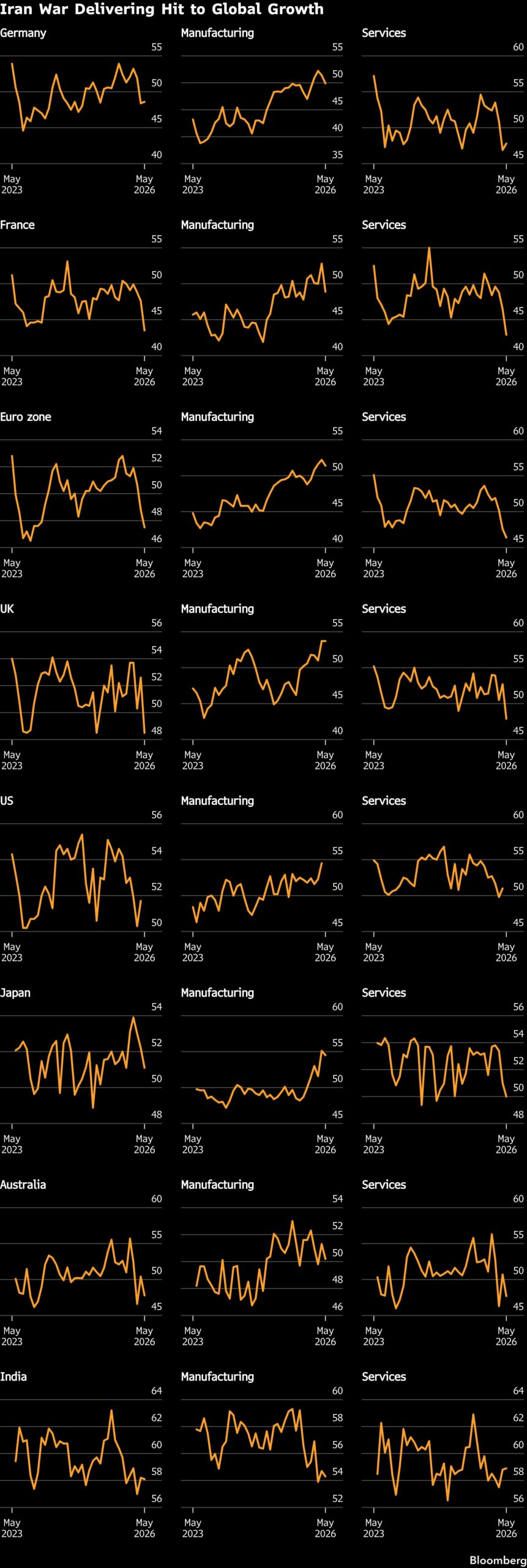
As with April, the worst impact was seen in the euro zone, with plummeting gauges in France delivering the biggest surprise. Manufacturing there and in the region’s biggest economy, Germany, has now just succumbed to a phase of shrinking activity.
Overall, the numbers add to evidence that the growth and inflation shocks to the world from the Middle East crisis are spreading, complicating the task for central bankers. Given the danger that price increases may take on momentum, they could end up having to raise borrowing costs even at the expense of a squeeze on enfeebled expansion.
The inflation worry and prospect of consequential interest-rate hikes is what’s gripped investors in the past week, with their grasp of the fiscal implications prompting a selloff in government bonds that sent long-term yields to the highest in more than two decades.
But the danger that comes with higher borrowing costs set by central banks is that expansion in some economies could grind to a halt or even going into reverse.
“There’s a pretty good chance, given how weak growth is in Europe, that we get something like a technical recession,” Melanie Baker, an economist at Royal London Asset Management, told Bloomberg Television. “You’ve absolutely got a whiff of stagflation at the moment.”
Of the survey results issued on Thursday, those for India and Japan revealed the greatest resilience. In both countries, manufacturing in particular maintained a relatively robust, albeit slowing, pace of expansion. Continued stockpiling efforts appeared to be helping Japanese firms, but the energy-cost impact also loomed.
“Prices data painted an increasingly concerning picture,” Annabel Fiddes, an economist at S&P Global, said in accompanying commentary. “If cost pressures continue to mount and demand softens, business confidence and the broader economy could come under greater strain.”
Australia, meanwhile, showed greater weakness, with the factory index dropping to show barely any growth and services abruptly shrinking. A measure of company sentiment matched a record low last seen at the height of the pandemic, though this time it was because of inflation worries.
It was in Europe — most notably in France — that the greatest growth hit appeared to be materializing. Business activity in the euro area shrank at the quickest pace in 2 1/2 years, buoyed only by continued stock-building within manufacturing. Overall resilience in the wider region defied contractions at factories in both of its biggest economies.
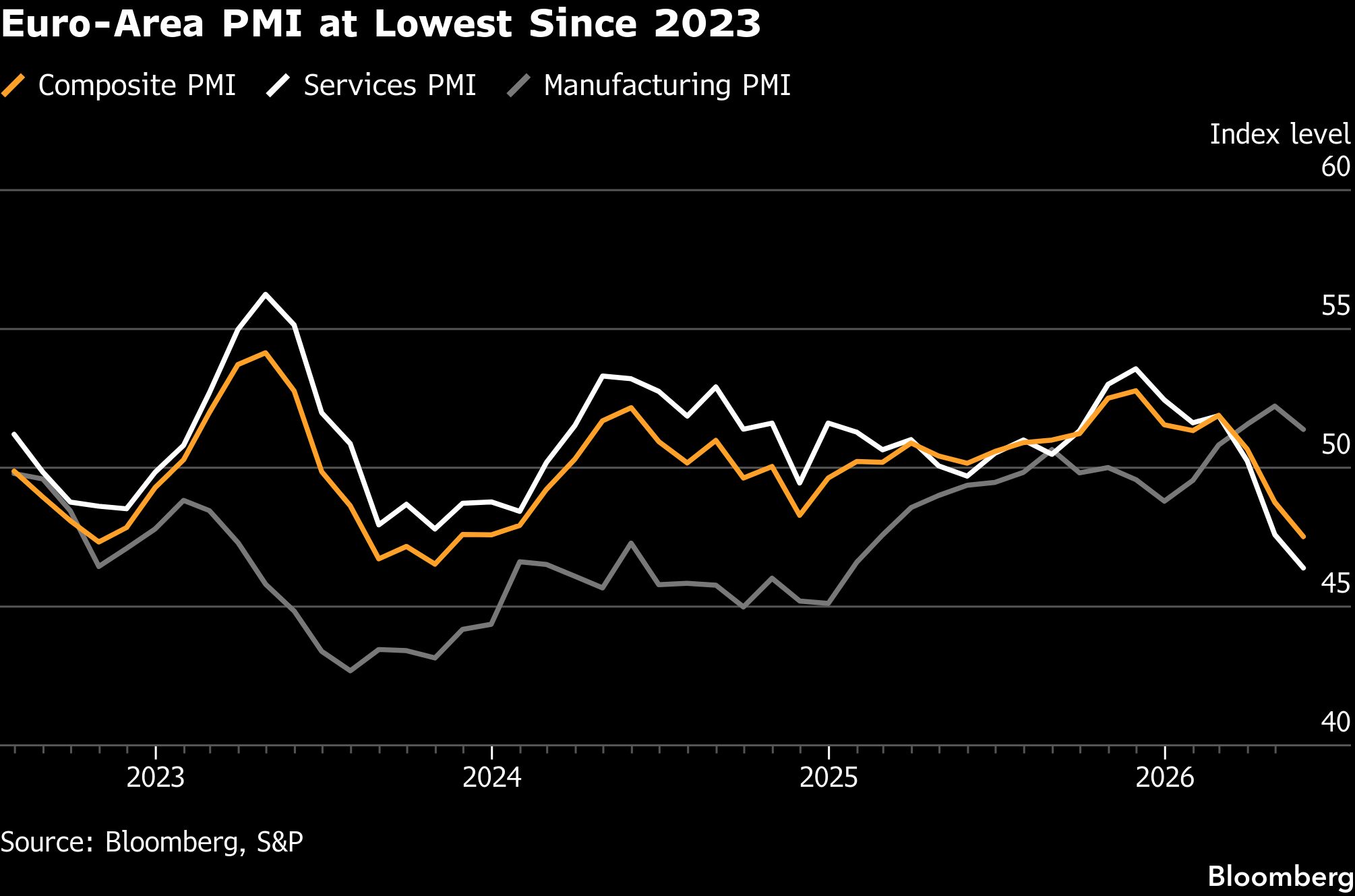
But with inflation measures also ticking up, the reports may only add to concerns at the European Central Bank that a rate increase is needed to prevent higher living costs becoming entrenched, even if it hurts growth in the process. On the eve of the reports, Belgian Governor Pierre Wunsch told Bloomberg Television that a hike on June 11 is “likely” if the war doesn’t end soon.
“The rise in the survey’s price gauges already hints at inflation running close to 4% in the coming months,” Chris Williamson, chief business economist at S&P Global Market Intelligence, said Thursday in a statement. That, “combined with the growing signs of the region slipping into an economic downturn, creates a deepening dilemma for policymakers.”
Over in the UK, its overall gauge showed the first decline in business output in over a year at a time when domestic political turmoil is weighing on sentiment. The last time it contracted was last April, when US President Donald Trump was imposing tariffs on British goods.
Manufacturing did continue to grow, but as is the case elsewhere that momentum is likely to go awry when customers’ inventories have been replenished in advance of higher prices.
Regarding Europe overall, Baker at Royal London said everything now hinges on whether the Iran war will endure, along with the blockage of the Strait of Hormuz at its epicenter.
“One of the things we’re clearly worried about here is how long this situation in the Middle East lasts,” she said. “Do we get into the situation where we do have shortages in multiple areas, and that really feeds through into a substantial hit to demand?”
Later on Thursday, US indexes will be released, with a decline in the manufacturing gauge and a slight increase in the services measure anticipated. Together, that would still suggest activity is weathering the international storm for now.
© 2026 Bloomberg

